Introduction
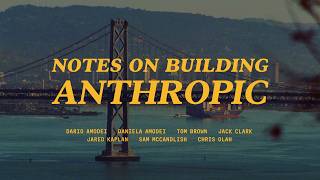
The film tells the story of the origin and evolution of Anthropic, founded by a group of experts striving to build safe artificial intelligence. The authors explain how transitioning to a Public Benefit Corporation model and focusing on model alignment allowed them to create advanced systems like Claude.
Key takeaways 5
The gist of the content in a few sentences
- A team of experts from OpenAI founded the company as a Public Benefit Corporation to prioritize safety and social mission over pure economic profit.
- The discovery that simply increasing computing power leads to a predictable increase in intelligence changed the perception of the pace of development toward human-level technology.
- Early systems struggled with hallucinations, but a breakthrough came with the Claude 3 Opus model, which reached the market forefront in terms of reasoning.
- Upon discovering the Mythos model's ability to find software vulnerabilities, the company restricted access to the technology to prevent its misuse.
- Despite focusing on risks, the company predicts that AI will enable dozens of scientific discoveries per month, particularly in biology and medicine.
Video chapters 11Click and the video will play from the selected moment
- 1:44From diverse disciplines to a shared AI vision
- 2:24A predictable path to human-level intelligence
- 4:15The mission and legal structure of the new organization
- 5:38Choosing the name and the chaotic early days
- 7:13From research experiments to the founding of Anthropic
- 7:35The evolution of the assistant and challenges with truthfulness
- 8:18The breakthrough with the Claude model and the helicopter test
- 10:28From catching up to the Claude 3 Opus breakthrough
- 11:31Safety at the forefront of AI development
- 12:33Responsible model deployment and project Glasswing
- 14:10A vision of benefits and the future of safe technology
Summary
First 3 of 11 partsFrom diverse disciplines to a shared AI vision
Anthropic's co-founders come from very different scientific and professional backgrounds, including theoretical physics, biology, global development, journalism, and programming. Many of them, such as those who studied at Princeton or worked at Johns Hopkins, initially saw their future in academia, but recognized AI as an opportunity for faster progress in their fields. For example, researchers focusing on cancer biomarkers at Stanford began to wonder if the development of computing technology would be the most effective path to progress in biology. This shared curiosity about how to make the world better united a group of experts who had previously worked at OpenAI on safety, policy, and model interpretability.
A predictable path to human-level intelligence
A key moment was noticing a trend that Dario called the great compute blob. It was observed that simply increasing the amount of data and computing power leads to an increase in model intelligence in a predictable way. Instead of explicitly teaching networks how to plan or reason, researchers observed that new skills emerge on their own as systems scale. This discovery led to the conclusion that human-level artificial intelligence could appear within our lifetime, rather than in a hundred years, paving the way for breakthroughs in medicine, robotics, and science.
The mission and legal structure of the new organization
Creating technology more powerful than humans carries immense risk, which the speaker compares to pharmaceuticals or the discovery of the secrets of the atom. Due to the potential social consequences, the founders decided it was necessary to build an organization tailored to the demands this technology places on the world. A key decision was to adopt the form of a Public Benefit Corporation on January 26, 2021. This structure allows Anthropic to prioritize mission and safety over maximizing shareholder value or pure economic incentives.
Read the full summary – for free
8 parts of text left, key takeaways, facts, questions and answers – with the source minute for every passage. Plus search, collections and the AI assistant.
Keep reading for freeFree, in a minute. Have an account? Log in